
Published: 2026-06-13
How Many Words Is a 3-Minute Speech? (Exact Count)
A 3-minute speech is 330–480 words depending on pace, ~390 at average. Get the WPM math, a two-point structure, and a 390-word template. Count yours now.
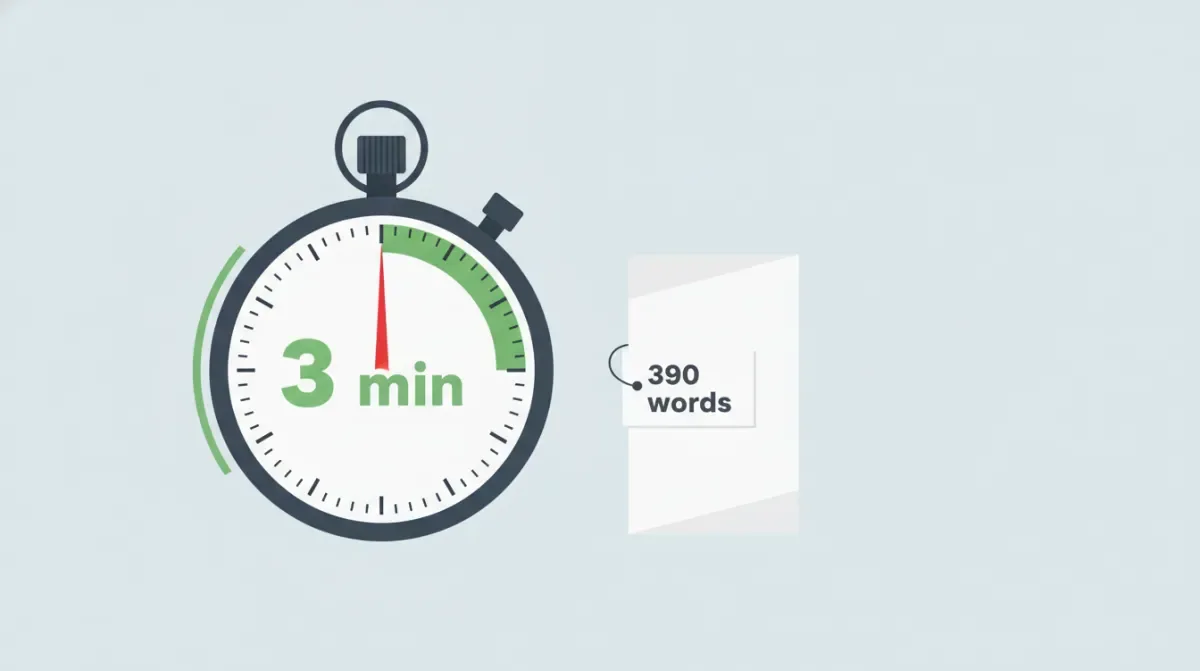
A 3-minute speech is about 390 words at an average speaking pace of 130 words per minute (WPM). Speak slowly and deliberately and you'll want around 330 words; deliver a fast, high-energy talk and you can stretch to 480. The realistic target for most people is 390 words — two clear points, one example, and a clean close.
Three minutes is a deceptively useful length. It's long enough to develop an argument, but short enough that a single tangent blows your timing. This is the slot for an interview answer, a wedding toast, a debate rebuttal, or a graded class presentation — formats where running over isn't just awkward, it costs you.
The 3-Minute Word Budget
Your word count is simply your pace multiplied by your time:
$$\text{Words} = \text{WPM} \times \text{Minutes} = 130 \times 3 = \textbf{390 words}$$
To check your draft against that number, paste it into our Word Counter — it runs entirely in your browser, so your script never leaves your machine — and read the word count alongside the built-in speaking-time estimate. To plan in the other direction, the Words to Minutes Calculator turns any duration into a word target at the pace you set; tap its 3-minute preset for an instant number.
Word Count by Speaking Pace
| Pace Category | Words Per Minute | 3-Minute Word Count | Best Use Case |
|---|---|---|---|
| Slow / Deliberate | 110 WPM | ~330 words | Emotional toasts, technical explanations, non-native audiences |
| Average / Conversational | 130 WPM | ~390 words | Interview answers, class presentations, debate rebuttals |
| Fast / Energetic | 160 WPM | ~480 words | High-energy pitches, lightning talks |
Notice the table stops at 160 WPM. Push past 170 and you're heading into the 200 WPM danger zone, where your audience stops following along. Treat 480 words as a hard ceiling for three minutes, not a goal.
Working with a different time slot? The per-minute math scales cleanly — our 2-minute speech guide covers the ~260-word range, and the 5-minute speech guide handles the 650–750 word range.
Why 3 Minutes Is the "Two-Point" Length
A 1-minute speech fits exactly one idea. Three minutes fits two — and that constraint is the whole trick to writing one well.
Budget roughly 130 words per point, leave a little for the hook and close, and you've used your 390 words. Try to force in a third point and you'll either rush all three or run long. The discipline isn't "say more," it's "develop two things properly." If you're cutting a bloated draft down to size, the techniques in our How to Reduce Word Count guide — killing filler phrases, swapping passive voice for active — are exactly what turns a 550-word ramble into a sharp 390-word talk.
Calculate Your Personal WPM
Don't trust the global average for a timed, high-stakes talk. Your real pace is measurable in three steps:
- Grab a sample. Take a 130-word chunk from your actual draft — your words, not a random paragraph.
- Read and time it. Read it aloud at your natural pace and clock it with a stopwatch.
- Do the math. Divide words by seconds, multiply by 60, then multiply by 3.
If those 130 words took you 56 seconds, you speak at about 139 WPM — so roughly 417 words is your true three-minute budget. Once you know that number, it's a constant you can reuse for every speech you write.
One caveat if you're not presenting in English: the budget is language-relative. German leans on long compound words, so a 3-minute German talk might be ~330 words; Spanish is less dense and often needs 430+ to carry the same idea. The 390 figure is an English baseline — and it's also why counting words by splitting on spaces breaks across languages. The Word Counter relies on Intl.Segmenter, the browser's language-aware word segmenter, to count any script correctly.
The Pause Tax
Pauses are part of delivery, not dead air — but they cost you words. In a 3-minute slot, a single 3-second pause for emphasis is about 1.7% of your runtime. Plan four or five deliberate beats and you've quietly spent 15–20 seconds, or roughly 40 words, saying nothing.
That's not a reason to skip pauses. It's a reason to budget for them. If you're planning several deliberate beats, drop your word target from 390 to about 350 so the silence fits inside the three minutes instead of pushing you over.
The 390-Word Template
Here's how a tight three minutes actually allocates — hover or tap a block to see its words, seconds, and pace:
That's ~390 words across 180 seconds. Notice there's no third point and no long recap — at this length, trying to add one is how a 3-minute speech becomes a panicked 4-minute overrun.
Prep the Script for Reading Aloud
Before you stand up, clean and check the script:
- Strip formatting noise. Text pasted from Docs or a PDF carries double spaces, non-breaking spaces, and stray line breaks that trip you up on a teleprompter. Our Remove Spaces tool clears all of it in one pass.
- Keep the language simple. A listener gets one pass at your words — they can't re-read. Run the draft through our Readability Score Checker and aim for a Flesch-Kincaid grade around 6–8.
- Read it on a 2:45 timer. If you're not done by 2:45, you're over budget. Adrenaline makes you talk faster on the day, so rehearse with headroom.
Lock It In
Open a stopwatch, set it for 2 minutes 45 seconds, and read your script out loud. If the timer beats you to the finish, cut words until you land under the wire with a breath to spare.
Ready to check your numbers? Paste your script into the Word Counter to see the exact word count and estimated speaking time, or use the Words to Minutes Calculator to set a 3-minute target and write toward it. Three minutes is enough time to say something that matters — if every word is pulling its weight.