
By kodewright · Published: 2026-04-30
How Many Words in a Cover Letter? (With Real Examples)
The ideal cover letter is 250–400 words. Exact targets by role type, what breaks the rule, and how to trim without losing impact.
A 2018 Ladders eye-tracking study found recruiters spend an average of 7.4 seconds scanning a resume before deciding to read further. Cover letters fare worse — many hiring managers skip them entirely unless the resume clears a threshold. When they do read it, you've got maybe 30 seconds.
The word count sweet spot: 250–400 words. Everything else is either too thin to make a case or too dense to survive first contact.
Why Cover Letter Length Actually Matters
Most writers think about what to say, not how much. That's backwards. The physical length of your cover letter — its visual weight on the page — signals effort, self-awareness, and respect for the reader's time before a single word is processed.
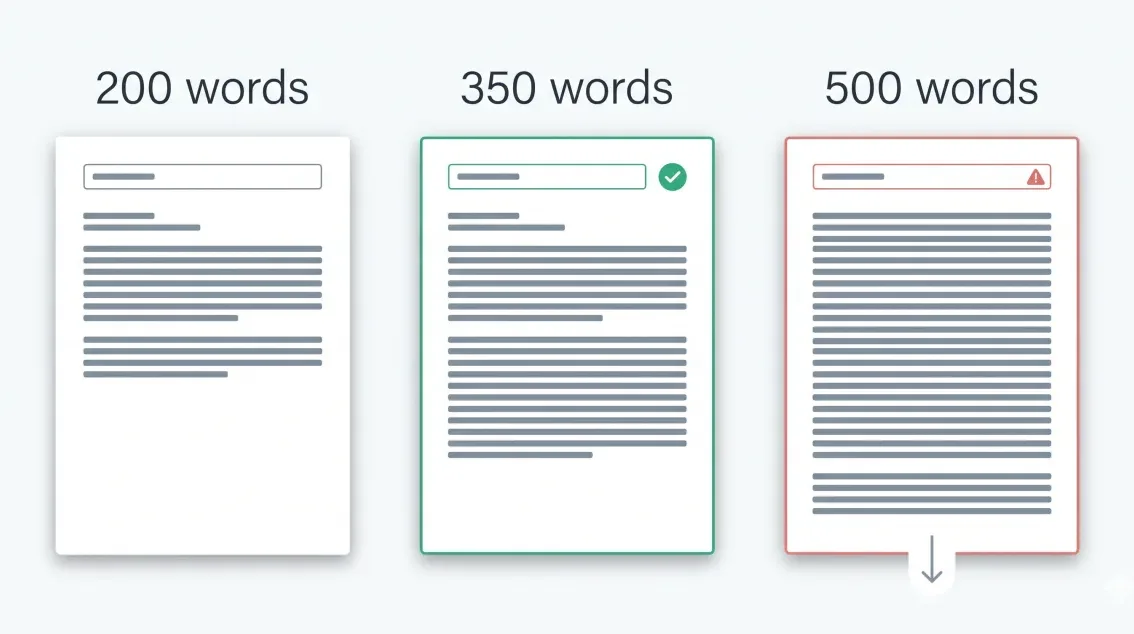
A letter under 200 words feels like you filled in a required field. A letter over 500 words in 12pt font with 1-inch margins risks spilling onto a second page, which most hiring managers won't flip to.
Here's the math: at 12pt Times New Roman, single-spaced with paragraph breaks, 250 words fills roughly half a page and 400 words fills about 80%. That's your target zone — substantive without becoming a wall of text.
One constraint worth knowing before you even start drafting: LinkedIn Easy Apply caps the cover letter field at roughly 2,000 characters. The Submit button stays disabled past that limit — it's client-side validation, not silent truncation. Check the portal's field constraints first.
Target Word Count by Role Type
Different contexts tolerate different lengths. Here's where the professional consensus lands:
| Role Type | Recommended Word Count | Why |
|---|---|---|
| Entry-level / recent grad | 200–300 words | Resume is thin; cover letter can only add so much without overpromising |
| Mid-level professional | 250–350 words | Strongest balance of context and brevity |
| Senior / executive | 300–400 words | Stakes justify specificity; recruiters expect strategic framing |
| Academic / research | 400–500 words | Longer is culturally accepted; teaching philosophy needs room |
| Creative roles | 150–250 words | Brevity demonstrates craft; the portfolio does the heavy lifting |
If the job posting includes explicit instructions ("no more than X words"), follow them exactly. When the portal enforces a limit, it enforces it — the field will reject further input once you hit the ceiling.
What Each Word Count Actually Looks Like
The 200-Word Skeleton
At 200 words, you can fit an opening (who you are + the role), one strong achievement with a metric, a one-sentence "why this company," and a closing call to action. It's tight. You're making one point, not three.
What's missing: You haven't addressed a career transition, haven't shown genuine company research, and haven't differentiated yourself from the next applicant who also has "five years of experience." Use 200 words when your resume already carries the argument and the cover letter is a formal intro note.
The 350-Word Goldilocks Zone
350 words gives you room to breathe. Structure it as:
- Opening (40–50 words): Name the role, cite one specific thing about the company — not "I've always admired your brand," but "Your Q4 2025 shift to composable architecture caught my attention."
- Achievement block (150–180 words): Two concrete accomplishments, each with a number. Not "improved team efficiency" — "cut deployment cycle from 3 days to 4 hours by refactoring the CI pipeline."
- Why them (60–80 words): One paragraph of genuine company-specific research. This is the section most applicants skip and most recruiters notice.
- Close (40–50 words): Short, direct, no summary of what you just said.
Here's what that looks like in practice — a real example hitting ~280 words for a mid-level product manager role:
Dear Sarah Chen,
I'm applying for the Senior Product Manager role at Linear. Your decision to remove the Gantt chart from your own roadmap — and ship it anyway — is the kind of deliberate product bet I want to be part of making.
For the past four years at Vercel, I led the product roadmap for the DX platform serving 600,000+ developer accounts. Two results that matter here:
In 2024, I shipped a redesigned CLI onboarding flow that cut time-to-first-deploy from 23 minutes to under 4. That change drove a 31% lift in 30-day activation across new team accounts. I got there by running 40+ user sessions myself — which is how I learned that our error messages were written for our infra team, not for the developers reading them at midnight.
In 2023, I managed the deprecation of three legacy API endpoints across 2,200 active integrations. Zero breaking changes in production. We shipped a migration guide, a compatibility shim with a hard sunset date, and direct outreach to the 80 accounts with the heaviest usage.
What draws me to Linear beyond the product direction: your changelog reads like a developer's blog post, not a press release. That voice comes from somewhere intentional, and I'd like to help build what comes next.
Available for a call this week or next.
Name
Notice what's not there: no "I am excited to apply," no list of soft skills, no restated resume summary. The hiring manager gets two metrics, one company-specific observation, and a clear ask — all in under 300 words.
The 500-Word Overshoot
A 500-word cover letter usually contains:
- A two-sentence opening that could be one sentence
- A life-story paragraph that belongs in a memoir, not an application
- Three achievement examples when one strong one would be enough
- A "furthermore" or two (a reliable signal you haven't edited)
- A closing that restates everything already said
Cut it to 350. The recruiter will notice the restraint.
If you're regularly hitting 500+ words in professional writing, the techniques in how to reduce word count apply directly — passive-to-active voice conversion alone typically cuts 10–15%.
ATS Systems and Cover Letter Length
Applicant Tracking Systems — Workday, Greenhouse, Lever, iCIMS — parse your cover letter for keyword frequency. They're doing pattern matching, not evaluating prose quality. ATS does not penalize length.
What ATS does care about: whether your cover letter contains the exact job title, key skills from the posting, and relevant industry terms. A 300-word letter with the right keywords outperforms a 600-word essay that buries them in metaphors.
The length penalty comes from the human — the recruiter who opens the letter in the ATS dashboard and decides in 15 seconds whether to click "Move Forward" or "Archive." Write for that person.
How to Trim a Bloated Cover Letter
If you've written 600 words and need to cut, start here:
- Delete every sentence that starts with "I am" or "I have." Rewrite as an action verb. "I have 5 years of experience" becomes "5 years building distributed systems across..."
- Kill throat-clearing openers. "I am writing to express my interest in the Role position" is pure overhead. Start with the hook instead.
- Strip formatting artifacts. If you drafted in Word and pasted into a portal, you likely carried double spaces, non-breaking spaces, and soft return characters. Run the text through our Remove Spaces — processes entirely in your browser, no upload, no account — to clean those out before pasting into the application field.
- Track your count live. Paste your draft into the Word Counter and watch the number drop in real time as you edit. Target under 400 before you submit.
The same discipline applies to academic writing: the word count for essays guide covers the 10% trimming rule in detail, and it works just as well on cover letters. Cut 10% by eliminating adverbs and redundant phrases, then re-read. The letter almost always tightens into something better.
The One-Page Visual Constraint
Word count and page length are related but not identical — font, margin, and line spacing all change the equation. Here's how the same 400 words sits on a page depending on your formatting choices:
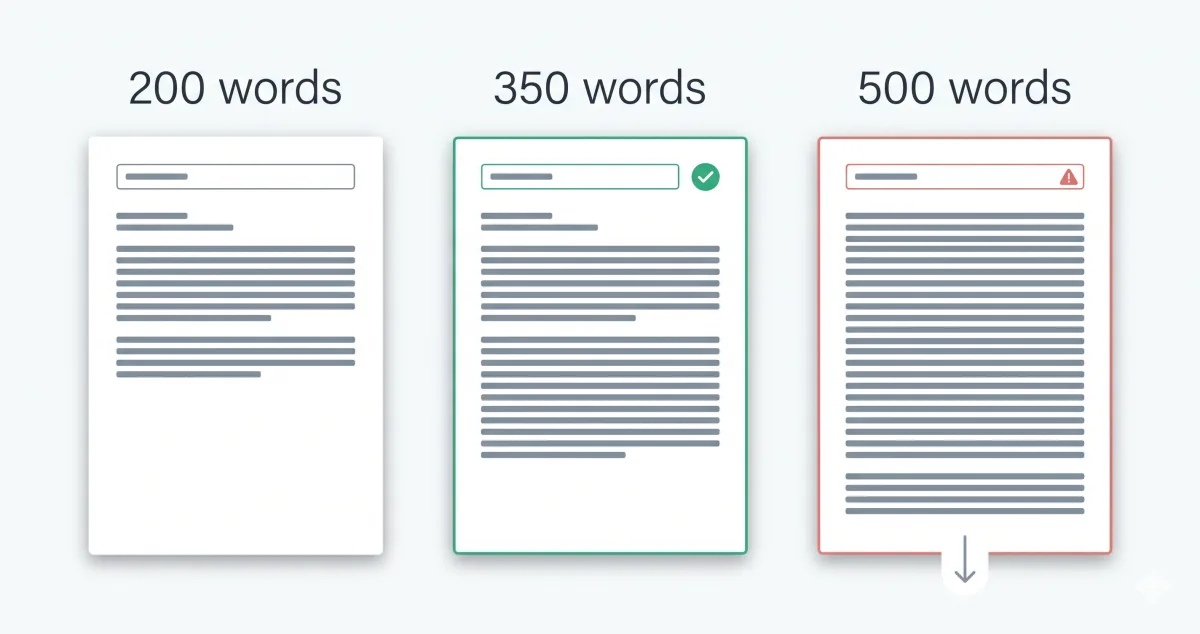
At the common formatting defaults:
- 12pt Times New Roman, 1-inch margins, single-spaced: ~500 words per page
- 11pt Calibri, 1-inch margins, single-spaced: ~550 words per page
- 11pt Arial, 1-inch margins, 1.15 line spacing: ~450 words per page
The practical ceiling is one page. At 400 words in any of these formats, you're safe. At 500 words with paragraph spacing, you're risking a second page. Most hiring managers won't turn to it.
If you're unsure how font and margin choices affect how much text fits on a page, the words-per-page formatting guide breaks down every variable — spacing, font size, and paper size — with exact counts.
Summary Checklist
Before you hit send:
- Word count is between 250 and 400 (or within the portal's stated limit)
- Opening names the specific role and a specific reason for applying
- At least one achievement has a concrete metric (%, $, time saved)
- One paragraph demonstrates company-specific research
- No sentence starts with "I am excited to" or "I believe I would be a great fit"
- Letter fits on a single page at your chosen font and size
- Pasted text has been cleaned of double spaces and invisible whitespace characters
A Note on Follow-Up Emails
If you send a follow-up after applying, the word count math flips. A follow-up email should be 50–100 words maximum — subject line included in your mental count. One sentence of context ("I applied for Role on date"), one sentence of genuine new value ("I shipped X last week that's directly relevant"), and a single clear ask. That's it. A follow-up that runs to 300 words reads as the same person who wrote the 600-word cover letter, still unable to edit themselves.
The Fastest Fix
Most cover letters aren't bad because they lack ideas. They're bad because they have too many, delivered with too many words. Trim to 300. Sleep on it. Trim another 10% in the morning.
Paste into the Word Counter and use the real-time count as your constraint. When the number stops dropping and every remaining sentence is load-bearing, you're done.