
By kodewright · Published: 2026-04-06 · Updated: 2026-10-26
Novel Word Count — The Ultimate Fiction Length Guide (2026)
How many words should a novel be? From flash fiction to epic fantasy, learn industry-standard word counts and how to hit your targets precisely.
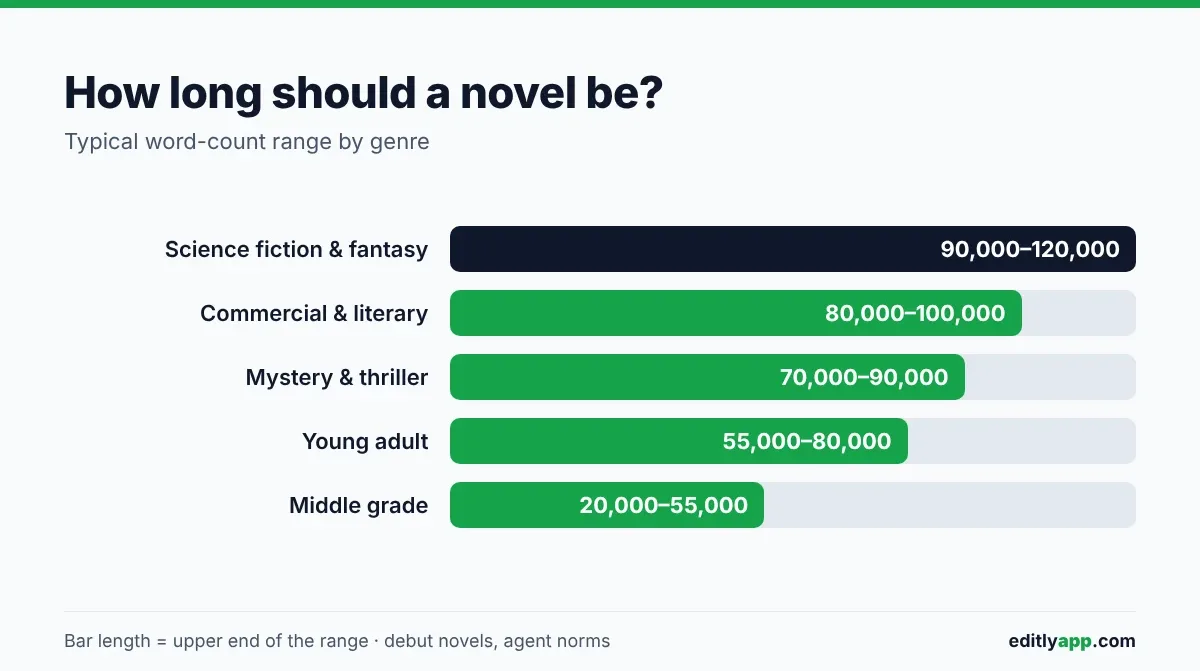
A debut novel usually runs 80,000 to 100,000 words. Short stories fall between 1,000 and 7,500 words, and novellas between 17,500 and 40,000. Agents use these ranges as a quick filter: a manuscript far outside its genre's range often gets a pass before anyone reads the first page, because length drives printing cost and tells them whether you know the market.
Treat the numbers below as ranges, not rules. Plenty of published books sit outside them. But a debut is judged on fewer signals than a veteran's book, and length is one of the cheapest ones to get right.
Fiction word counts by format
The category boundaries below follow the ones used for the Nebula Awards (SFWA), which most of the fiction world has adopted informally.
| Format | Word count range | What it's for |
|---|---|---|
| Flash fiction | 100 – 1,000 | One idea, very tight. |
| Short story | 1,000 – 7,500 | A single arc or situation. |
| Novelette | 7,500 – 17,500 | Complex shorts, serial installments. |
| Novella | 17,500 – 40,000 | A strong premise without much subplot. |
| Novel | 40,000 – 120,000+ | Full plot, subplots, character change. |
To see where your draft stands, paste the chapters into the Word Counter. I built it so the text never leaves your browser; there's no server that could store a manuscript.
Word counts by genre
Genres have different norms, mostly because readers expect different things. A cozy mystery and a space opera don't need the same room. If you send an agent a 150,000-word romance, they won't read it as ambition. They'll read it as not knowing the market.
Commercial and literary fiction: 80,000–100,000. The safest range for a debut. It's long enough to carry a complex plot and short enough to keep the cost of a printed book reasonable.
Mystery, thriller and crime: 70,000–90,000. Pacing carries these books. A thriller over 100,000 words usually has description slowing the action down, and that's the first thing to cut.
Science fiction and fantasy: 90,000–120,000. World-building takes space, so agents tolerate more length here. Epic fantasy still has a ceiling for a debut, and 120,000 is already pushing it.
Young adult and middle grade: YA runs 55,000–80,000 words and middle grade 20,000–55,000. The shorter lengths follow what those readers pick up and finish.
If your draft is too long or too short
Too long: The usual cause is subplots that don't touch the main character's arc. Cut any scene that doesn't change something for them. Then look for repeated description: if the ominous castle gets three paragraphs, the reader needs the first one. When you've made cuts, the Text Diff Checker shows what you removed from each chapter compared with the earlier draft. For sentence-level trimming, see how to reduce word count.
Too short: A 55,000-word thriller is closer to a novella than a novel. Padding won't fix it. Look for scenes you summarized ("they argued for an hour") and write them out. Give the antagonist some scenes from their own point of view, or add a subplot with a deadline that tightens the main one.
Chapter length
Chapters don't have an official length, but consistency matters. If one chapter is 1,500 words and the next is 8,000, the reader notices the change in pace whether or not they could say why. Common ranges:
- Thrillers: 1,500–3,000 words, short enough to keep things moving.
- Fantasy: 3,000–5,000 words, with room for atmosphere.
- Literary fiction: 2,000–4,000 words.
If the chapters are uneven, the fix is in the content: cut or expand. Before you send a chapter to a beta reader or an agent, run it through Remove Spaces to clean up double spaces, broken line breaks from PDFs and non-breaking spaces left over from months of copy-paste. They won't change your word count, but they make a manuscript look careless.
Fan fiction has no gatekeepers
Nobody screens fan fiction before it goes up, so a 500,000-word story is allowed. Length still signals something to readers on fan fiction archives: a 2,000-word one-shot promises a quick hit, and a 100,000-word slow burn promises a long stay in the same world.
From word count to printed pages
Agents think in words, but readers and printers think in pages. The conversion depends on font, line spacing and trim size, so there's no single answer. A 90,000-word manuscript comes out noticeably shorter on a larger trim with a small font than on a small trim with a large one. How many words per page walks through the arithmetic, including US Letter and A4 for formatted sample pages.
How to state your word count in a query letter
Round to the nearest thousand. "My thriller THE VUE FROM HERE is complete at 84,000 words" is the right level of detail. "It's 83,742 words including the dedication" isn't, because the agent only wants to know which bracket you're in. Query letters usually print the title in capitals, and the Case Converter will do that for you.
Planning a daily word count
Divide the target by your daily output to get a schedule:
- 500 words a day: a 90,000-word draft in about six months.
- 1,000 words a day: about three months.
- 2,000 words a day: about six weeks, which few people can keep up.
Pick the number you can repeat on a bad day, not a good one. The hard part is holding it for months. The Writing Goal Tracker takes a daily or total goal (say 90,000 words) and a running total after each session. It logs only the words added since your last entry, so pasting the whole draft every time won't double-count, and a day you haven't finished yet won't break an existing streak. Goals and history are stored in your browser's local storage, with no account.
Frequently asked questions
Does the prologue count toward the total word count?
Yes. Everything in the narrative body counts, prologue and epilogue included. Front matter such as the dedication, and back matter such as acknowledgments, doesn't.
Can a debut novel be 120,000 words?
It can, but it's a harder sell. In fantasy or historical fiction it's possible. In romance or a contemporary thriller it tells the agent you may not have cut enough.
How do I fix my word count if I'm over the limit?
Start with filler phrases. Find & Replace can swap "in order to" for "to" and "due to the fact that" for "because" across the whole manuscript in one pass. That usually trims a few percent. After that you're cutting scenes.
What is the word count for a children's picture book?
Usually 500 to 1,000 words. The illustrations carry part of the story, so the text has to be very economical.
Is word count the same as character count?
No. Word count is the number of words, and the Word Counter finds word boundaries with Intl.Segmenter, so it also works for languages that don't separate words with spaces. Character count includes every letter, digit, space and punctuation mark. Agents ask for word count. Character count only matters for things like social posts and metadata fields.