
By kodewright · Published: 2026-05-02
How Many Words is a Chapter? By Genre Breakdown
Chapter word counts by genre: thriller (1,500–3,500), fantasy (4,000–10,000), YA (1,500–3,000), romance (2,000–4,000). NaNoWriMo math included.
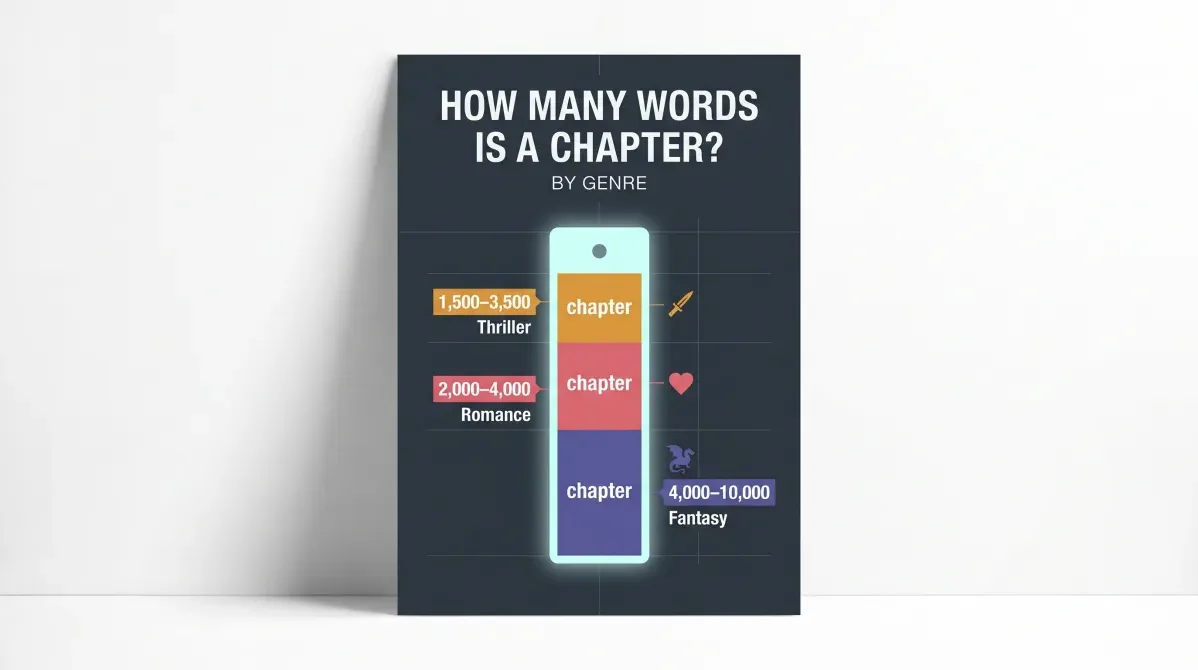
Most commercial fiction chapters run 2,000 to 5,000 words. That's the honest, useful answer. But genre moves the target dramatically: a thriller chapter at 5,000 words is bloated; an epic fantasy chapter at 2,000 words feels like a scene stub.
Here's the full genre breakdown, then the reasoning behind each range.
Chapter Word Count by Genre — The Reference Table
| Genre | Chapter Word Count | Total Novel Length | Avg. Chapters |
|---|---|---|---|
| Thriller / Mystery | 1,500–3,500 | 70,000–90,000 | 25–60 |
| Romance | 2,000–4,000 | 75,000–100,000 | 20–40 |
| Literary Fiction | 2,000–5,000 | 80,000–100,000 | 20–50 |
| Young Adult (YA) | 1,500–3,000 | 60,000–90,000 | 25–50 |
| Middle Grade | 1,000–2,500 | 20,000–50,000 | 15–30 |
| Epic Fantasy / Sci-Fi | 4,000–10,000 | 90,000–120,000+ | 15–30 |
| NaNoWriMo draft | 1,500–2,000 | 50,000 | 25–30 |
These ranges come from analyzing traditionally published manuscripts in each genre — not from a single style guide. Publishers don't publish chapter-length requirements, but agents and developmental editors internalize them from reading thousands of submissions.
To get a live count on any chapter you're drafting, paste it into our Word Counter — processes everything locally in your browser, no text ever leaves your device — and you'll see word count, reading time, and sentence complexity in real time.
Why Chapter Length Isn't Arbitrary
A chapter is a unit of cognitive load, not just a formatting convention. Readers hold a scene's tension in working memory. When that tension resolves — or snaps — the chapter ends. The genre contract determines how long readers expect to hold that tension before they need a release.
Thriller readers have been conditioned to expect short, tight chapters. Fast cuts. Cliffhangers every 2,000 words. James Patterson took this to an extreme: his chapters sometimes run 200–400 words. That's a stylistic choice, but it reflects the genre's core demand: constant forward momentum.
Epic fantasy readers have made the opposite contract. They want to settle into a world. A 6,000-word chapter in a Brandon Sanderson novel doesn't feel slow — it feels like value. The world-building is the product, and cramming it into 2,000-word bites would feel rushed.
The rule: chapter length should match the cognitive rhythm your genre has trained readers to expect.
Thriller and Mystery: Short and Ruthless
Target range: 1,500–3,500 words.
The standard structure is "scene + sequel": something happens (scene), a character reacts and decides (sequel). In thrillers, the sequel is often cut almost entirely — or deferred until the next chapter — to prevent momentum loss. A 5,000-word thriller chapter almost always contains a scene that should have been two chapters, or a reaction sequence that should have been cut.
The practical math: a 75,000-word thriller at 2,500 words/chapter gives you 30 chapters. That's a brisk, well-paced read. At 40 chapters (1,875 words each), it starts to feel fragmented. At 20 chapters (3,750 words each), it risks dragging.
If your thriller chapters are running long, the techniques in How to Reduce Word Count apply directly — specifically cutting nominalization ("she made a decision" → "she decided") and trimming reaction sequences after high-stakes scenes.
Romance: Emotional Beats Need Space
Target range: 2,000–4,000 words.
Romance chapters need to do more internal work than thrillers. The reader needs access to the POV character's emotional state, which takes words. A romantic tension scene that pays off in 1,500 words often feels unearned — like the author told us the character fell in love rather than showing the slow accumulation of signals.
That said, romance readers move fast. An 8-chapter act spanning 30,000 words is a structure problem, not richness. Break those longer chapters at natural scene shifts — when the setting changes, when a new character enters, or when the emotional register shifts significantly.
Literary Fiction: Structure Is Optional (But Word Count Still Matters)
Target range: 2,000–5,000 words, but with notable exceptions.
Literary fiction is the genre that most often breaks chapter conventions entirely. Cormac McCarthy's The Road has no chapter breaks at all. Some literary novels use numbered sections of 500 words; others use 60-page untitled parts. The "rules" are weakest here.
That said, debut literary fiction benefits from staying near the commercial range. An agent reading a debut with 18,000-word chapters is not seeing ambition — they're seeing a structural edit that hasn't happened yet. If you intend to write long, long chapters as a deliberate choice, make sure every word is earning its place.
Epic Fantasy and Science Fiction: Earn the Length
Target range: 4,000–10,000 words, sometimes higher.
This is the one genre where long chapters are not automatically a problem. World-building requires context. A magic system, a political structure, a non-Earth geography — these have to be established before they can pay off, and that takes pages.
Robert Jordan's Wheel of Time averages 8,000–12,000 words per chapter. Patrick Rothfuss's The Name of the Wind runs similarly long. These aren't editorial failures — they're the genre contract in action.
The caveat: length is earned by density, not padding. A 9,000-word fantasy chapter that advances plot, deepens character, and enriches worldbuilding is worth every word. A 9,000-word chapter that's 4,000 words of travel description followed by a 5,000-word dinner scene is a structural problem with extra commas.
For fantasy writers, the Novel Word Count guide covers how total manuscript targets differ by genre — useful for checking whether your chapter math adds up to a publishable length before you finish the draft.
Young Adult: Respect the Reading Speed
Target range: 1,500–3,000 words.
YA readers are fast. They're also primarily reading for emotional identification with the protagonist — every chapter needs to move that relationship forward. Long chapters in YA tend to fail not because readers can't handle the length, but because the pacing slows below what the genre's readers expect.
The practical ceiling: 4,000 words in a YA chapter without a strong external event (not just internal reflection) is a warning sign. YA allows introspection, but it has to be moving.
Middle Grade: One Idea Per Chapter
Target range: 1,000–2,500 words.
Middle grade chapters are structurally the tightest. One scene. One clear problem encountered or advanced. Reader age (8–12) shapes this directly — not because younger readers can't follow complexity, but because the genre's books are often read across multiple short sessions, so chapters that can be completed in 10–15 minutes have a structural advantage.
Jeff Kinney's Diary of a Wimpy Kid chapters average around 600–800 words. That's an extreme optimized for reluctant readers. Most MG chapter books run closer to 1,500–2,000 words per chapter.
NaNoWriMo: The Chapter Math Behind the Month
NaNoWriMo's goal is 50,000 words in 30 days — that's 1,667 words per day. If you write one chapter per day, your chapters average 1,667 words. Most participants write slightly longer chapters less consistently, landing at 25–30 chapters of 1,500–2,000 words each.
Here's the reality check no one puts on the website: 50,000 words is a novella, not a novel.
| Genre | NaNoWriMo Target | Publishable Target | Gap |
|---|---|---|---|
| YA | 50,000 words | 65,000–80,000 | +15,000–30,000 |
| Romance | 50,000 words | 75,000–100,000 | +25,000–50,000 |
| Thriller | 50,000 words | 70,000–90,000 | +20,000–40,000 |
| Literary | 50,000 words | 80,000–100,000 | +30,000–50,000 |
Your NaNoWriMo draft is structural scaffolding. The chapters you write at 1,667 words will expand in revision to 2,500–4,000 words as you add scenes, deepen character, and fix plot holes. That's the correct use of the month: get the skeleton down, then flesh it out.
The failure mode in November isn't writing badly — it's losing the thread of where you actually are. A daily target only works if you can see the running total against it, which is what the Writing Goal Tracker is for: set 1,667 words/day, log your manuscript's total after each session, and it records the delta rather than the raw number, so re-pasting a growing draft never double-counts. It also tracks the consecutive-day streak, which for most participants matters more than the arithmetic.
How to Audit Your Chapter Lengths
Before you hit revision, know exactly what you have. Paste each chapter one at a time into the Word Counter — you'll see word count, sentence-level stats, and reading time per chapter in seconds.
Then run each chapter through the Word Frequency Counter to surface overused words. Writers have verbal tics that cluster by chapter: the same verb appearing 12 times in 2,500 words, a character name repeated every other sentence, filler adverbs stacking up in action sequences. The frequency counter runs on Intl.Segmenter tokenization client-side, so even proper nouns with apostrophes and hyphenated compound words are counted correctly. It catches patterns that find-and-replace misses entirely.
The combination — word count per chapter plus frequency analysis — gives you an objective baseline before a developmental editor charges you by the hour.
When to Split a Long Chapter
A chapter that's outgrown its genre range is almost always two chapters wearing a trench coat. Signs it should be split:
- Two distinct locations that could each stand alone as a scene setting
- A natural midpoint climax — a revelation, confrontation, or decision — that would land harder as a chapter ending than buried in the middle
- POV shift (if you're writing multi-POV) where each perspective could hold its own chapter
- Pacing contrast — an action sequence followed by a long reflective sequence that drags the chapter's exit energy down
The split point is usually obvious once you read the chapter looking for it: find where the reader would naturally exhale, and end the chapter there.