
By kodewright · Published: 2026-05-09
Readability Score Explained: Flesch-Kincaid & More
Flesch-Kincaid, Reading Ease, Gunning Fog — what each formula measures, how the scores work, and exactly how to improve your writing's grade level.
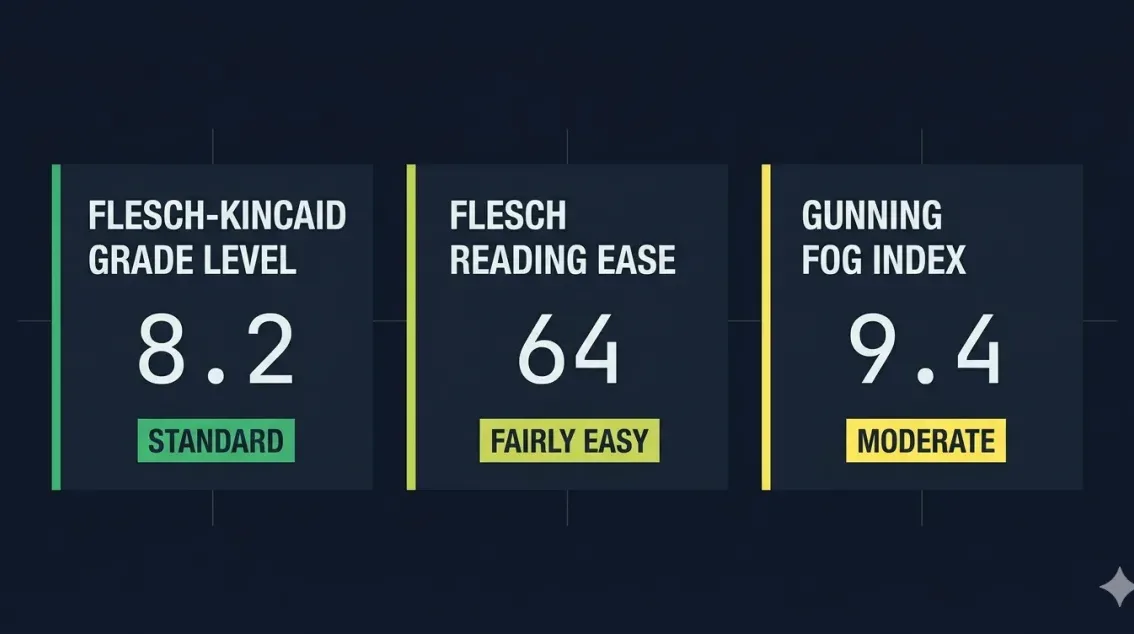
Your text can be technically correct, logically structured, and still fail the reader. That's what readability scores measure — not whether your ideas are sound, but whether the sentence complexity and word length match your audience's reading level.
Three formulas dominate the field. Here's what each one measures, how the math works, and what to do with the numbers.
The Three Readability Formulas
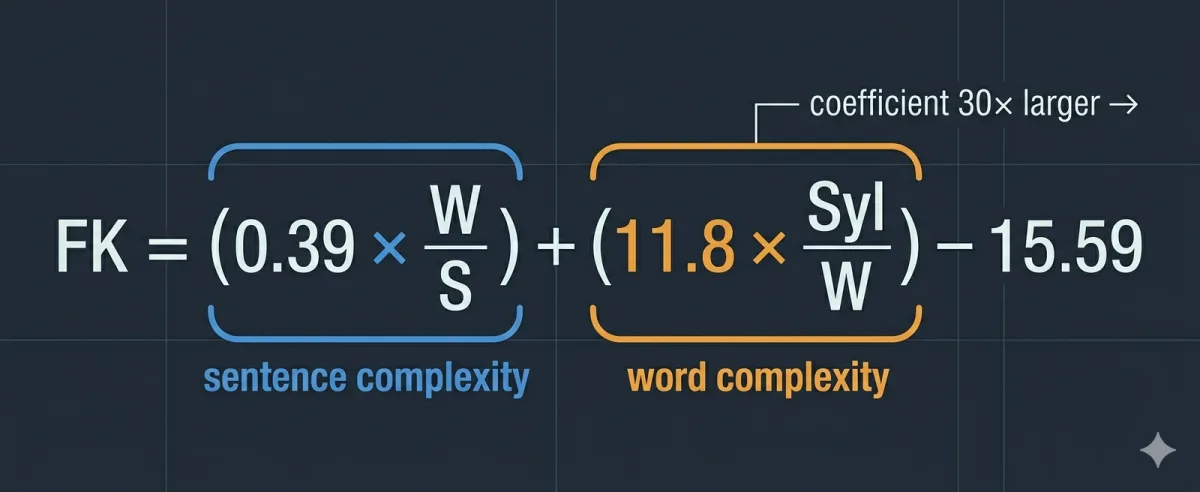
Flesch-Kincaid Grade Level
FK Grade Level = (0.39 × words per sentence) + (11.8 × syllables per word) − 15.59
| Term | Input | Coefficient | What it controls |
|---|---|---|---|
| Sentence complexity | avg words ÷ sentences | × 0.39 | How long your sentences run |
| Word complexity | avg syllables ÷ words | × 11.8 | How polysyllabic your vocabulary is |
| Calibration | — | − 15.59 | Shifts the output into grade-level range |
The coefficient on syllables per word (11.8) is 30× larger than the one on sentence length (0.39) — which makes it look like vocabulary complexity dominates. It doesn't in practice. Sentence length varies far more in real text than syllables per word. A sentence trimmed from 40 words to 15 moves the grade level by ~10 points; replacing every Latinate word in the same sentence might move it by 1–2.
The output is a US school grade. Grade 8 means an 8th-grader reads it comfortably. Most US newspapers target grade 7–9. Legal contracts often score grade 16+. The formula was commissioned in 1975 by the US Navy — they needed a way to verify that training manuals were actually legible to recruits with varied education levels. Rudolf Flesch (a journalist) and J. Peter Kincaid (a researcher) built it. Not academic theory — operational tooling.
Flesch Reading Ease
Reading Ease = 206.835 − (1.015 × words per sentence) − (84.6 × syllables per word)
| Term | Input | Coefficient | Effect on score |
|---|---|---|---|
| Baseline | — | + 206.835 | Maximum possible without penalties |
| Sentence penalty | avg words ÷ sentences | × −1.015 | Longer sentences pull the score down |
| Syllable penalty | avg syllables ÷ words | × −84.6 | More complex words pull it down sharply |
The syllable penalty (−84.6) is ~83× larger than the sentence penalty (−1.015). Reading Ease reacts much more to vocabulary choice than to sentence length — one dense technical paragraph can drop the score by 10–15 points on its own.
Output is 0–100. Higher is easier. This trips people up every time — the scale is inverted relative to what most people expect. A score of 80 means 8th-grade readers can breeze through it. A score of 20 means you've written something that requires a law degree to parse. The same Rudolf Flesch published the original version of this formula in 1948 for US Navy training materials. Kincaid adapted it in 1975 into the grade-level variant.
Gunning Fog Index
Fog = 0.4 × (avg words per sentence + 100 × complex words ÷ total words)
Output is similar to FK Grade Level — a grade number where higher equals harder. "Complex words" is defined precisely: three or more syllables, excluding proper nouns and verb forms where a suffix (-ed, -es, -ing) is what pushes the word to three syllables. "Collected" (col-lect-ed, 3 syllables) doesn't count. "Incomprehensible" (6 syllables) does. Gunning Fog punishes jargon harder than Flesch-Kincaid because the complex-word count is a direct input, not just a proxy via average syllables per word.
If your Fog score stays stubbornly high despite reasonable sentence lengths, the culprit is usually a cluster of technical terms appearing repeatedly. Use the Word Frequency Counter to see which 3+-syllable words dominate your text — those are your targets to replace or define in plain language before the first use.
Score Reference Table
| Flesch Reading Ease | FK Grade Level | Difficulty | Typical content |
|---|---|---|---|
| 90–100 | Grade 5 | Very Easy | Board books, simple instructions |
| 80–90 | Grade 6 | Easy | Young adult fiction, casual blogs |
| 70–80 | Grade 7 | Fairly Easy | Popular news, general-interest articles |
| 60–70 | Grade 8–9 | Standard | Most web content, marketing copy |
| 50–60 | Grade 10–12 | Fairly Difficult | Specialist publications, business reports |
| 30–50 | Grade 13–15 | Difficult | College-level academic writing |
| 0–30 | Grade 16+ | Very Difficult | Legal, medical, postgraduate research |
Before you write: decide where your audience sits in this table. A research abstract submitted to a peer-reviewed journal belongs at grade 13+. A patient-facing FAQ on a medical website should land at grade 6–8 maximum. Optimizing for the wrong row is just as damaging as ignoring scores entirely.
How to Check Your Score
Paste your text into our Readability Score Checker — every calculation runs in your browser's V8 engine, your text never leaves your machine — and you'll see all three scores plus a full stat breakdown: word count, sentence count, syllable count, average words per sentence, and complex word count.
The Word Counter also shows Flesch-Kincaid Grade Level and Flesch Reading Ease alongside word/sentence counts and reading time, if you want all your stats in one place while drafting.
What native tools offer:
- Microsoft Word: Readability statistics exist but are hidden. Go to File → Options → Proofing → "Show readability statistics," then run the spell-checker. The Flesch score appears in the statistics window after spell-check completes. Not exactly streamlined.
- Google Docs: No native readability feature. None. Third-party add-ons exist but require granting account permissions.
- Notion: No readability support.
The Syllable Counter Problem
Here's what most readability articles skip: there's no public API for syllable counts in English. Every tool — including ours — uses a heuristic algorithm.
The most common method is vowel-group detection with silent-e removal: count vowel groups (consecutive vowels count as one group), then subtract a syllable if the word ends in a silent 'e'. In practice:
| Word | Vowel groups | Silent-e adjustment | Result |
|---|---|---|---|
| calculate | cal-cu-late | none | 3 syllables ✓ |
| create | cre-ate | −1 (trailing 'e') | 1 syllable ✗ (it's actually 2) |
| beautiful | beau-ti-ful | none | 3 syllables ✓ |
| receive | re-ceive | −1 | 1 syllable ✗ (it's actually 2) |
Heuristics break on irregular words. That's why two tools scanning identical text can produce different readability scores — their syllable counters disagree on a few dozen words, and those errors compound across a full document.
The practical implication: don't optimize toward a specific score on one tool. Focus on the direction of change. If your FK Grade Level drops from 13 to 10 after an editing pass, the text genuinely improved — regardless of what any other tool shows for the same text.
The Counterintuitive Scale: Higher Flesch = Easier
Worth repeating because it causes consistent confusion.
Flesch Reading Ease is structured so that higher scores mean more readable text. The formula subtracts complexity from a baseline constant (206.835). Longer sentences and more syllables per word pull the number down.
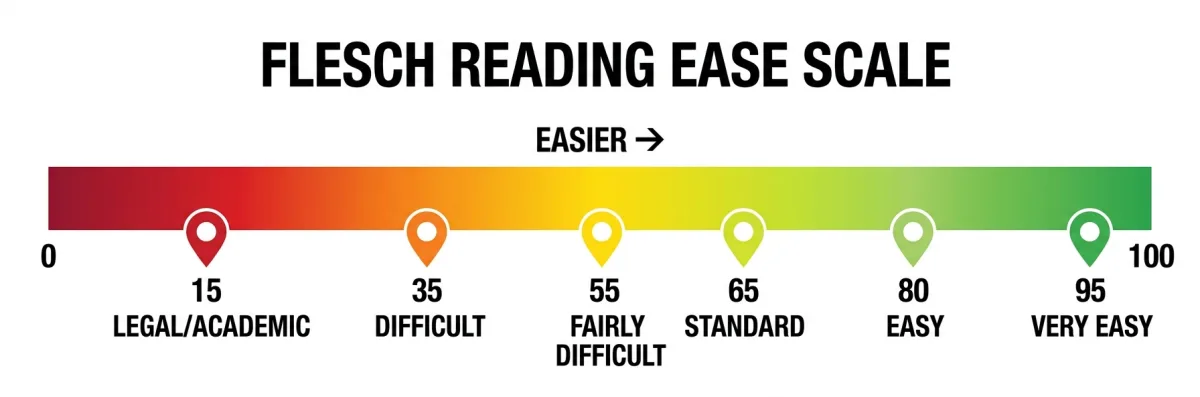
Flesch Reading Ease — 0 to 100 (↑ higher = easier to read)

 95–100 ████████████████████  "The cat sat on the mat." — Grade 1–4, children's books
  80–90 ████████████████░░░░  Casual blogs, young adult fiction — Grade 6
  70–80 █████████████░░░░░░░  New York Times average article — Grade 7
  60–70 ██████████░░░░░░░░░░  Harvard Business Review — Grade 8–9
  50–60 ████████░░░░░░░░░░░░  Specialist industry reports — Grade 10–12
  30–50 █████░░░░░░░░░░░░░░░  Scientific American — Grade 13–15
   0–30 ██░░░░░░░░░░░░░░░░░░  Legal contracts, academic papers — Grade 16+
Flesch-Kincaid Grade Level has no such inversion. Grade 8 is a real 8th-grade reading level. Grade 16 is genuinely postgraduate. Straightforward mapping.
Gunning Fog follows the same grade-level convention — higher number, harder text.
If someone tells you "your Flesch score is 82," ask which Flesch they mean. Reading Ease of 82 is good. Grade Level of 82 doesn't exist (the scale stops around 20 in practice, though the formula can technically output higher numbers).
How to Actually Improve Your Score
The formulas make the levers explicit. Two inputs drive all three scores: words per sentence and syllables per word. Everything else follows from those.
Reduce sentence length (biggest lever):
The words-per-sentence term has the largest coefficient in the Flesch-Kincaid formula (0.39 multiplies average sentence length, 11.8 multiplies syllables per word — but sentence length variation has more room to move in practice). Split any sentence over 25 words into two. Remove throat-clearing openers:
| Before | After |
|---|---|
| It is important to note that the API returns… | The API returns… |
| As previously mentioned, the limit is… | The limit is… |
| Due to the fact that responses are async… | Because responses are async… |
Reduce syllable complexity:
Prefer Anglo-Saxon words over their Latinate equivalents. English has two vocabularies — the short Germanic layer and the longer Latin/French layer. The Germanic words are almost always shorter:
| Latinate (avoid) | Germanic (prefer) |
|---|---|
| utilize | use |
| demonstrate | show |
| facilitate | help |
| commence | start |
| terminate | end |
Also watch for nominalization — turning verbs into nouns adds syllables with no benefit:
- "We made an assessment of the system" → "We assessed the system" (cuts 4 words, 4 syllables)
- "There was a reduction in error rates" → "Error rates fell" (cuts 5 words)
For a systematic approach to cutting bloated text, the techniques in how to reduce word count apply directly here — filler phrases add words and syllables simultaneously, so cutting them improves both density and readability.
A 20% word count reduction typically drops the Flesch-Kincaid Grade Level by 2–3 points. That's usually enough to push a "fairly difficult" article into "standard" range.
Readability and SEO: The Real Connection
Google hasn't confirmed readability as a direct ranking signal. What it has confirmed: user engagement metrics — time on page, scroll depth, return visits — are quality signals. Complex text correlates with high bounce rates. Readers who can't follow your sentences leave fast.
Google's E-E-A-T (Experience, Expertise, Authoritativeness, Trustworthiness) evaluation also rewards content that genuinely serves its stated audience. A personal finance article targeting recent graduates, written at grade 15, is failing its readers regardless of keyword coverage or backlink count. Quality raters flag that mismatch.
The nuance: match the score to the audience, not to an imaginary "best" number. For academic writing contexts — dissertation chapters, research proposals, peer-reviewed submissions — grade 13+ is expected and correct. The same grade level on a landing page for a general consumer product is a conversion problem.
The stakes are even higher for children's content. Every children's book category has a strict grade-level target by age — an easy reader written at grade 7 isn't just hard to read, it's structurally wrong for the format and will be rejected by publishers who know exactly what controlled vocabulary looks like. Readability score isn't a suggestion in that market; it's a specification.
Why Scores Differ Between Tools (The Technical Version)
Two sources of variance:
1. Syllable heuristics diverge. Every readability tool implements its own counter. Depending on the algorithm, "beautiful" may count as 2 or 3 syllables, "area" as 2 or 3. Multiplied across a 2,000-word article, a few syllable disagreements per hundred words shifts the final score meaningfully. There's no authoritative syllable-count dataset that tools agree to use.
2. Word counting differs. Tools using text.split(' ') or regex patterns like /\b\w+\b/g miscount hyphenated compounds and return incorrect words-per-sentence values. In JavaScript, \w only matches [A-Za-z0-9_] — it silently fails on any non-Latin script, and \b has no concept of Unicode word boundaries. Our checker uses Intl.Segmenter (the W3C standard for language-aware tokenization) with /\p{L}+/gu (Unicode Property Escapes, u flag required) for accurate word boundary detection across all scripts.
The takeaway: cross-tool score comparison isn't meaningful. Pick one tool and track your changes within it. The direction of movement is the signal; the absolute number is implementation-dependent.
All three formulas — Flesch-Kincaid Grade Level, Flesch Reading Ease, Gunning Fog — are measuring the same two things from different angles: how long your sentences are and how complex your words are. Fix both, and all three scores move in the right direction. Split the long sentences first. That's where the biggest leverage is.