
By kodewright · Published: 2026-05-04 · Updated: 2026-11-03
Children's Book Word Count: The Age-by-Age Guide
Exact word count ranges for every children's book category — board books to YA. Know before you write, not after you've revised 12 times.
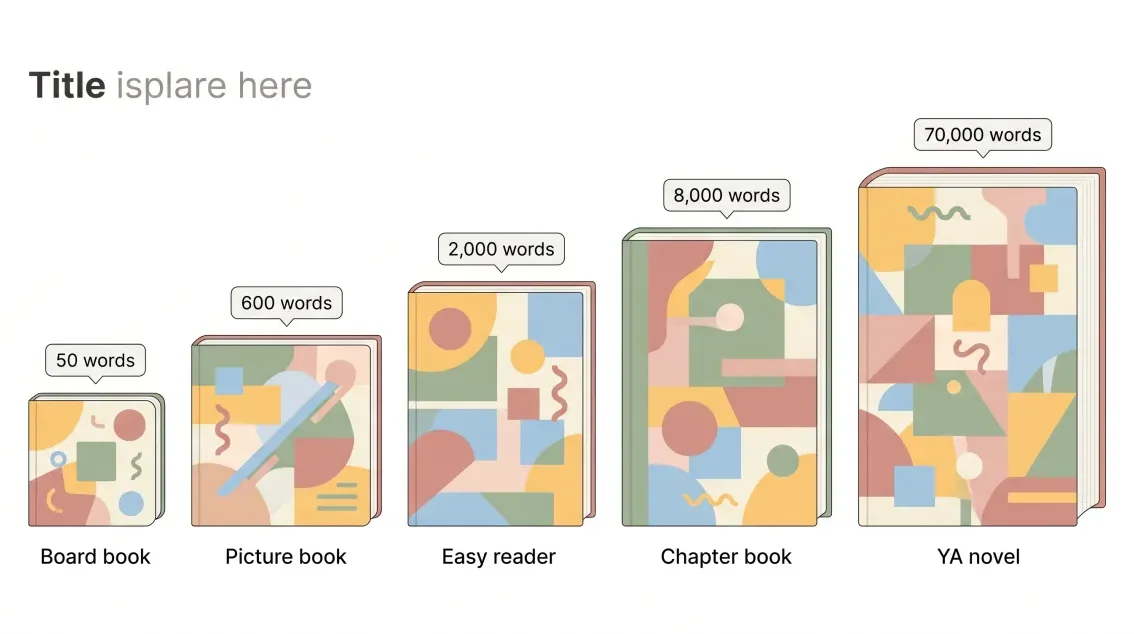
A children's book can run from **0–100 words (board books for toddlers) up to 80,000 words (young adult novels). The category sets the target, not the other way around.
Here's the full table, then the details for each category.
Children's book word count by category
| Category | Age range | Word count range | Notes |
|---|---|---|---|
| Board Books | 0–2 | 0–100 | Often 0–50; repetition is the point |
| Early Picture Books | 2–4 | 100–500 | Simple vocabulary, large type, few words per page |
| Picture Books | 3–5 | 500–800 | Most guides point at 500–600 |
| Easy Readers | 5–7 | 1,000–3,500 | Controlled vocabulary (Dolch/Fry sight-word lists) |
| Chapter Books | 6–10 | 4,000–10,000 | About 8–12 short chapters of 400–1,000 words |
| Middle Grade | 8–12 | 20,000–50,000 | Debut target: 30,000–45,000 |
| Young Adult (YA) | 12+ | 50,000–80,000 | Fantasy tops out around 100,000; contemporary stays lower |
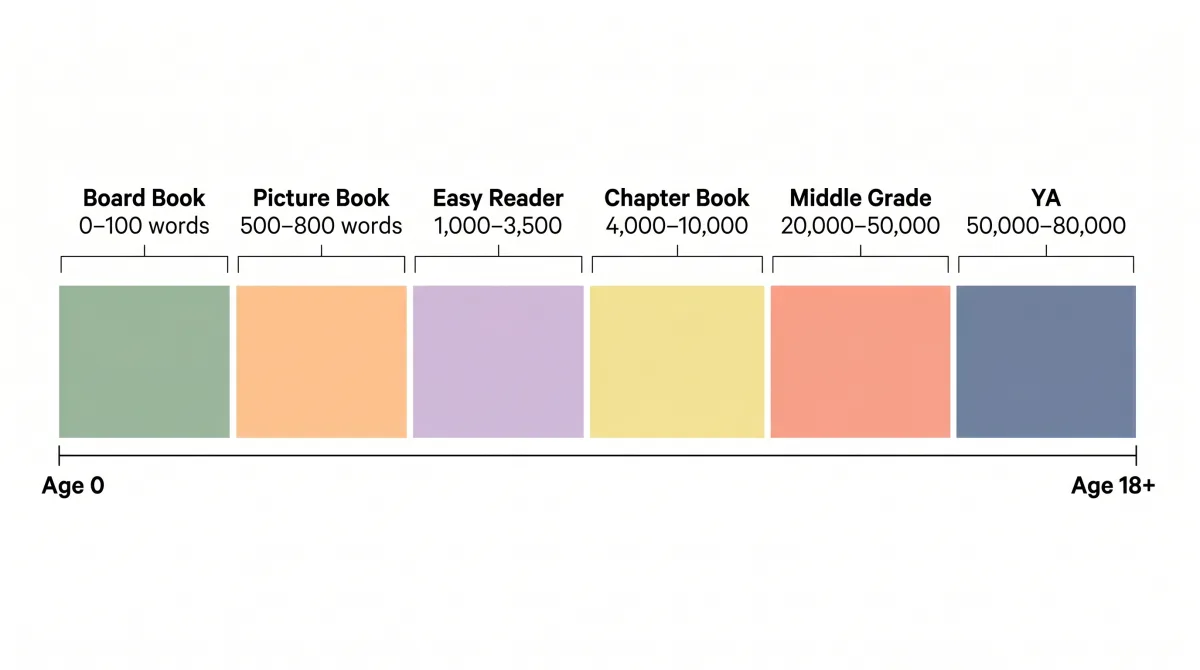
I read children's books aloud to kids, and how long a book feels depends on the age of the child. That's a good way to read this table: a number that works for a five-year-old at bedtime would lose a two-year-old on page six.
To check a manuscript as you draft, paste it into the Word Counter. The text stays in your browser's memory and nothing is sent anywhere.
Board books (age 0–2): 0–100 words
Board books are a format of their own, built for children who chew, bend and point at pictures.
Aim for 50–100 words; many classics come in under 50. The page count sets the budget. A board book usually has 12–14 spreads, and one short sentence per spread of 5–8 words gives you 60–112 words in total.
What tends to work is repetition with a small change each time: "Big dog. Small dog. Tall dog. Short dog." The text is built around a concept (colors, opposites, animals, numbers) and a pattern, not a plot. If you're writing a plot, you're already in picture book territory.
Early picture books (age 2–4): 100–500 words
This is the stretch between board books and standard picture books: simple concept books or very small stories, with large type and about a sentence per page, leaning heavily on the illustrations.
Aim for 100–500 words in words a 2–4 year old already knows or is learning. What separates this range from the next is sentence complexity as much as length: present tense, active voice, concrete nouns, no flashbacks.
Picture books (age 3–5): 500–800 words
Most new children's authors aim here, and most run over.
Most guides suggest 500–600 words, and many editors and agents treat anything above 800 as a warning sign. The reason is production. A standard picture book is 32 pages, which leaves about 14 double-page spreads for the story. At 500 words that's roughly 35 words per spread, enough for two or three sentences while the illustration carries most of the meaning.
If you read picture books aloud, the arithmetic is easy. At the 130 words-per-minute conversational pace used across this site, 500–600 words takes about 4–5 minutes, which fits a bedtime slot. The Words to Minutes tool does the same sum for your own manuscript.
Eric Carle's The Very Hungry Caterpillar is roughly 224 words. These books show how much the pictures do. If your manuscript reads fine with no pictures, you may be writing prose fiction, not a picture book.
Rhyming picture books keep the same word count, but the craft bar is higher. If the meter breaks in line four, a reader rarely gets to line five, so rhyme only if you can do it well.
Easy readers (age 5–7): 1,000–3,500 words
Easy readers (series such as "I Can Read" and "Step Into Reading") confuse many authors: they're long enough for chapters but still very short.
Aim for 1,000–3,500 words, split into short chapters of 200–400 words. The big difference from picture books is controlled vocabulary. These books are built around lists of words children already recognize on sight, such as the Dolch list (220 words) or the Fry list (1,000 words). Too many unfamiliar words on a page frustrates a beginning reader.
Keep sentences to about 7–8 words and paragraphs to 2–3 sentences. The series publishers define their own levels, each with its own word limit, so if you're writing for a series, get its guidelines first and match them.
Chapter books (age 6–10): 4,000–10,000 words
Chapter books are where illustrated novels live: Captain Underpants and Junie B. Jones are typical. They're longer than easy readers, shorter than middle grade, and often have drawings throughout.
Aim for 4,000–10,000 words in 8–12 short chapters of 400–1,000 words. Short chapters give a young reader a place to stop, and "one more chapter" is easier to say yes to when a chapter takes five minutes. First-time authors can aim for 6,000–8,000 words: long enough for a full arc and short enough to revise.
Middle grade (age 8–12): 20,000–50,000 words
Middle grade is a real novel with character arcs and subplots, compressed compared to adult fiction.
For a debut, aim for 30,000–45,000 words. Some reference points, all approximate:
- Charlotte's Web (E.B. White): about 32,000 words
- The Giver (Lois Lowry): about 43,000 words
- Harry Potter and the Sorcerer's Stone: about 77,000 words, far above the usual range and a poor benchmark for a debut
Fantasy and sci-fi can push toward 50,000 because world-building uses up words. Contemporary middle grade usually lands around 28,000–40,000. Past 55,000 words, go through the manuscript chapter by chapter and compare each one with the ranges in how many words is a chapter. Often a couple of chapters carry the story and the rest are padding.
Young adult (age 12+): 50,000–80,000 words
YA is a marketing category, not a strict age limit. The Hunger Games is about 100,000 words and Twilight about 118,000, both from authors whose books were selling, so they're poor models for a debut. For a first book, 60,000–80,000 is the safer range.
| YA genre | Target word count |
|---|---|
| Contemporary YA | 55,000–75,000 |
| YA Thriller / Mystery | 60,000–80,000 |
| YA Fantasy / Sci-Fi | 70,000–100,000 |
| YA Literary Fiction | 55,000–70,000 |
For most YA genres a debut tops out around 80,000 words, and fantasy can stretch to 100,000. Beyond that, a debut needs a strong reason for the length. YA drafts tend to sag in the middle once subplots start swelling the chapters. How to Reduce Word Count covers cutting passive voice, nominalizations and doubled-up words, which is where most of that length goes.
Counting your manuscript
Paste your text into the Word Counter and read the total at the top. For a picture book, paste only the manuscript, not your illustration notes. Those are directions for the artist, not words on the page.
The counter uses Intl.Segmenter, the standard API for word boundaries in different languages. It splits hyphenated compounds, so "well-loved" counts as two words and "three-year-old" as three. Microsoft Word counts each of those as one. For a picture book sitting at 790 words, that difference can matter, so count the way the submission guidelines say they count.
Why publishers care about word count
It's mostly production. Picture books are 32 pages because printed sheets are folded into signatures of fixed page counts. If your text needs 18 spreads instead of 14, you're asking for a different, more expensive book.
For easy readers the reason is calibration. The vocabulary lists come from studies of what beginning readers recognize, and a book that strays far from its level stops being useful for the teachers and parents choosing it.