
Published: 2026-05-26
How Many Words Is a 1-Minute Speech? (Exact Count)
A 1-minute speech is 130–150 words at a natural pace. Get the exact WPM math, an elevator-pitch breakdown, and how to time it. Count your script now.
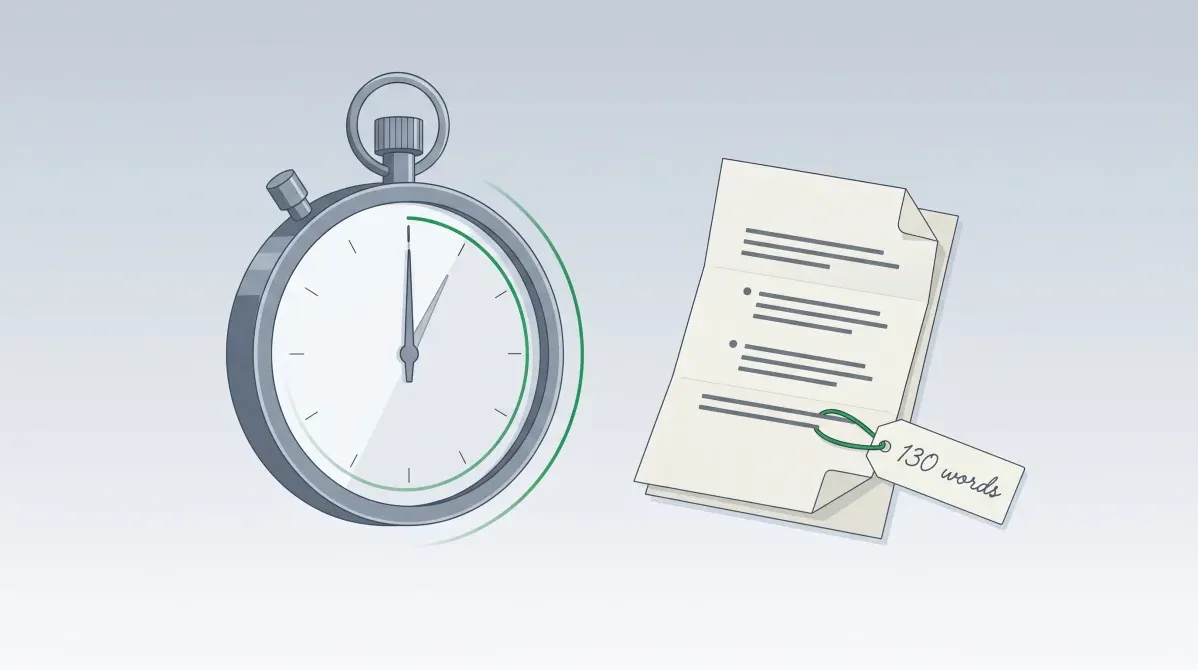
A 1-minute speech is 130 to 150 words at an average speaking pace of 130–150 words per minute (WPM). Speak slowly for emphasis and you'll want 100–120 words; deliver a fast, high-energy pitch and you can stretch to 160–170. The realistic sweet spot for most people is about 140 words — one clean idea, delivered without rushing.
Here's the counterintuitive part: a 1-minute speech is harder to write than a 5-minute one. With five minutes you can ramble and still recover. With sixty seconds, every word is load-bearing. There's no room for a throat-clearing intro, no room for a tangent, no room for the second example you're attached to. It's the difference between writing an essay and writing a headline — brevity is a constraint, not a luxury.
The 60-Second Word Budget
Think of your minute as a fixed budget. Your speaking pace is the spend rate, and 60 seconds is all you've got. Try to fit in more than it holds and your delivery overflows — you either talk too fast or get cut off mid-sentence.
To get your script number before you start cutting, paste it into our Word Counter — it runs 100% in your browser, nothing is ever sent to a server — and check both the word count and the built-in speaking-time estimate (calculated at 130 WPM). That estimate is your reality check against the table below. Want the word target for a different pace or slot? The Words to Minutes Calculator converts any duration to a word count — and back — at the WPM you pick.
Word Count by Speaking Pace
| Pace Category | Words Per Minute | 1-Minute Word Count | Best Use Case |
|---|---|---|---|
| Slow / Deliberate | 100–120 WPM | 100–120 words | Emotional toasts, technical points, non-native audiences |
| Average / Conversational | 130–150 WPM | 130–150 words | Elevator pitches, intros, Toastmasters Table Topics |
| Fast / Energetic | 160–170 WPM | 160–170 words | Lightning intros, high-energy hooks |
Notice the table stops at 170. Anything past that and you're sprinting toward the 200 WPM disaster zone, where comprehension falls off a cliff. In a one-minute slot you have no time to recover from talking too fast, so treat 170 as a hard ceiling, not a target.
Need a longer slot? The per-minute math scales cleanly: our 3-minute speech guide covers the ~390 word range, the 5-minute speech guide the 650–750 range, and the 10-minute speech guide keynote-length timing at 1,300–1,500 words.
Calculate Your Personal WPM
Don't trust the global average for a high-stakes minute. Your real pace is measurable in three steps:
- Grab a sample. Take a 130-word chunk from your actual draft — not a random paragraph, your words.
- Read and time it. Read it aloud at your natural pace and clock it with a stopwatch.
- Do the math. Divide words by seconds, multiply by 60.
$$\text{WPM} = \frac{\text{Words}}{\text{Seconds}} \times 60$$
If those 130 words took you 58 seconds, you speak at roughly 134 WPM — so 130–135 words is your true one-minute budget. Once you have that number, it's a constant you can reuse for every speech you ever write.
One caveat if you're not presenting in English: the word budget is language-relative, not universal. German leans on long compound words, so ~110 of them can fill a minute; Spanish is less dense and often needs 160+ to carry the same idea. The 130–150 figure is an English baseline — calibrate it to the language you're actually speaking. (This is also why counting words by splitting on spaces breaks down across languages, and why the tool relies on Intl.Segmenter instead.)
Why Pauses Cost More in a Short Speech
Pauses are deliberate silences that let the audience process what you said. But in a 60-second slot, the math is brutal. A single 3-second pause for effect eats 5% of your entire runtime. Two of them and you've spent a tenth of your speech saying nothing.
That's not a reason to skip pauses. It's a reason to budget for them. If you're planning two deliberate beats, drop your word target from 140 to about 125. The silence is part of the script, even though it never shows up in the word count.
The Elevator Pitch Connection
The phrase "elevator pitch" exists because of this exact constraint: the time between floors. A solid elevator pitch is 30–60 seconds, or roughly 75–150 words, and the 60-second version is literally a 1-minute speech with a job to do — one hook, one value statement, one ask.
If you're writing that pitch for a job hunt, the same discipline applies to your written materials. The trimming techniques in our How to Reduce Word Count guide — killing filler phrases, swapping passive voice for active, deleting nominalizations — are exactly what turns a bloated 220-word ramble into a sharp 140-word pitch. Cutting a speech and cutting a cover letter use the same scalpel.
Keep the Language Simple (Listeners Can't Re-Read)
A reader can scan a sentence twice. A listener gets one pass. So a one-minute speech should sit at a lower reading grade than the same idea in print — short sentences, common words, no nested clauses.
Run your draft through our Readability Score Checker and aim for a Flesch-Kincaid Grade Level around 6–8. If it's coming back at grade 12, your audience is doing mental compilation while you're already three sentences ahead. We break down what each score actually means in the Readability Score Explained article — for spoken word, lower is almost always better.
Prep the Script for Reading Aloud
Before you stand up, do a final prep pass on your script:
- Strip formatting noise. Text pasted from Docs or a PDF arrives with double spaces, non-breaking spaces, and stray line breaks that trip you up on a teleprompter. Our Remove Spaces tool clears all of it in one pass so your eyes glide instead of stumbling.
- Mark your emphasis. Toggle a key phrase to UPPERCASE with the Case Converter as a visual cue to land the word — a marker on the page you can't miss.
- Read it on a 50-second timer. If you're not done by 0:50, you're over budget. Leave headroom for the pauses and the inevitable nerves bump.
About those nerves: rehearse at 130 WPM and you'll likely hit 145+ on stage. Adrenaline speeds everyone up on the day. Leave yourself headroom now so a fast delivery lands at 60 seconds instead of finishing awkwardly at 0:48.
The 140-Word Template
Here's how a tight 60 seconds actually allocates — hover or tap a block to see its words, seconds, and delivery pace:
That's ~140 words across 60 seconds. Notice there's no second example and no recap — there isn't time, and trying to force one is how a one-minute speech becomes a panicked 90-second overrun.
Lock It In
Open a stopwatch, set it for 55 seconds, and read your script out loud. If the timer beats you to the finish, you're carrying too many words — cut until you land under the wire with a breath to spare.
Ready to check your numbers? Paste your script into the Word Counter to see the exact word count and your estimated speaking time, then trim until that minute fits like it was measured to the second. Because in a one-minute speech, it was.